
Exercise physiology and physiotherapy are both allied health professions that help people move and function better, but they focus on different things. Physiotherapy is a broad, hands-on profession that assesses, diagnoses and treats movement problems — including injury, pain, mobility and physical function. Exercise physiology specialises in using exercise itself as the main tool, designing safe, structured programs to build strength, fitness, capacity and long-term health.
If you’re an NDIS participant, family member or support coordinator trying to work out which discipline fits a person’s goals, this guide explains the difference in plain English — and how the two can work well together.
The Short Version: Focus and Approach
Both professions are university-qualified, registered allied health disciplines. The key difference is the primary tool each uses and the type of goal they’re usually working towards.
| Physiotherapy | Exercise Physiology | |
|---|---|---|
| Main tool | Assessment, manual techniques, movement retraining, targeted exercise | Structured exercise programs, delivered and progressed over time |
| Typical focus | Restoring movement, managing pain, improving mobility and physical function after injury or illness | Building long-term capacity — strength, fitness, endurance, confidence with activity |
| Common questions | “Why does this hurt?” “How do I walk more safely?” | “How do I get stronger and more independent over months, not weeks?” |
| Timeframe | Often shorter episodes of care around a specific issue | Ongoing programming with regular review and progression |
Neither is “better” — they simply suit different goals, and many people benefit from both at different times.
What Physiotherapy Typically Involves
Physiotherapists are movement specialists trained to assess how the body moves and why something might not be working as it should. In a mobile or telehealth setting, a physiotherapist might:
- Assess balance, walking, transfers and everyday movement at home
- Work on strength, flexibility and coordination after injury, surgery or a change in condition
- Help manage pain through movement strategies and activity modification
- Recommend mobility aids or equipment approaches (often alongside occupational therapy)
- Support participants with neurological or developmental conditions to move more confidently
Because physiotherapy is assessment-driven, sessions often begin with working out what the problem is before deciding how to address it. You can read more on our mobile physiotherapy page.
What Exercise Physiology Typically Involves
Exercise physiologists (often called AEPs, or Accredited Exercise Physiologists) are trained specifically in clinical exercise. Rather than treating a single injury in isolation, they design and deliver exercise programs that build capacity over weeks and months. That might look like:
- A progressive strength or conditioning program tailored to the participant’s goals and abilities
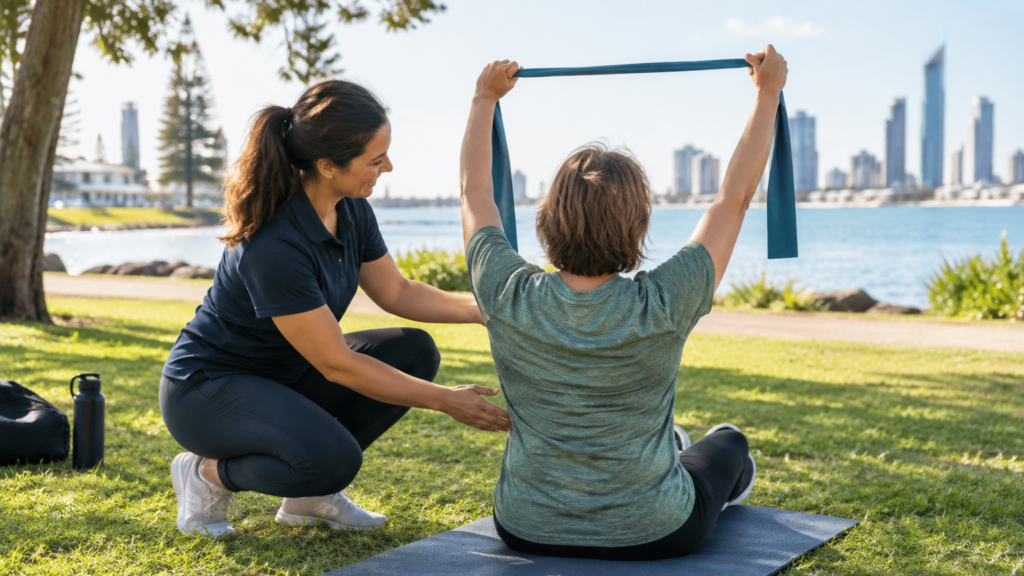
- Supervised sessions at home, in the park, at a pool or in the gym — wherever the person is comfortable
- Coaching so the participant (and their support network) can keep the program going between sessions
- Regular review and progression as strength, fitness and confidence grow
Exercise physiology is especially well suited to goals like building endurance for community outings, improving strength for daily tasks, or establishing a sustainable, enjoyable activity routine. See our exercise physiology page for how we deliver this.
When Might You Choose One Over the Other?
There’s no single right answer, but these questions help narrow it down:
- Is there a specific, immediate problem? New pain, a recent fall, a change in mobility or a recovery goal often points to physiotherapy first.
- Is the goal long-term capacity? Getting stronger, fitter and more independent over time often points to exercise physiology.
- Is the person unsure what’s causing the issue? A physiotherapy assessment is usually the sensible starting point, with a referral to exercise physiology afterwards if appropriate.
- Is there already a clear program in place? An exercise physiologist can deliver, supervise and progress it.
Can They Work Together?
Absolutely. A common pattern is a physiotherapist assessing and setting the direction of care, then an exercise physiologist building a program around that direction and carrying it forward. Good communication between disciplines — and with the participant’s other supports — matters more than which one starts first.
How This Works with Mobile and Telehealth Delivery
Both disciplines lend themselves well to mobile and telehealth delivery. Sessions can happen at home, in the backyard, at a local park or pool, or via video call for coaching, program reviews and progress check-ins. For NDIS participants, this often means:
- No travel to a clinic, which saves energy and time
- Exercises practised in the real environment where they’ll actually be used
- Support workers and family members able to observe and learn how to assist between sessions
Progressive delivers both physiotherapy and exercise physiology by mobile and telehealth across the Gold Coast, Brisbane, Logan, Toowoomba, Ipswich and Northern NSW.
Frequently Asked Questions
Do I need a referral to see an exercise physiologist or physiotherapist?
No referral is needed to contact us directly. You can get in touch by phone or email and we’ll talk through your goals and what a first session might look like. Funding arrangements vary between participants, so it’s worth checking your plan or speaking with your support coordinator or plan manager about what your funding covers before committing.
Can I see both a physiotherapist and an exercise physiologist?
Yes. Many participants use both at different stages — for example, physiotherapy to assess and address a specific movement issue, then exercise physiology to build strength and capacity over the longer term. The two disciplines often coordinate their approach.
What happens in a first session?
Either way, a first session is usually about getting to know you: your goals, your history, your environment and what a realistic, useful program looks like for you. You won’t be pushed into anything on day one — the aim is to understand where you’re starting from.
Talk to Us About the Right Fit
Still not sure which discipline suits your goals? That’s completely normal — and it’s exactly the kind of conversation we’re happy to have. Call us on 0410 268 144 or email admin@progressiverespite.com.au, or head to our booking page to get started.