
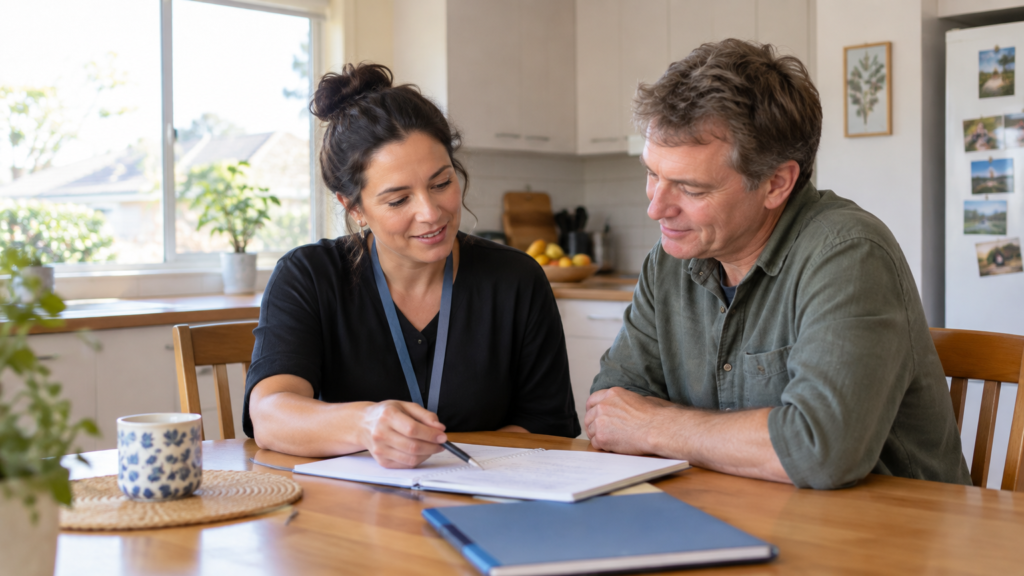
Matching a participant with the right therapy mix is less about picking disciplines from a menu and more about working backwards from their goals, routines and environment. When therapy happens in the home or community rather than a clinic, the setting itself becomes part of the intervention, so the mix you choose needs to fit the places where the participant actually lives their life. Here’s a practical way to think it through, followed by a worked example.
Start with goals, not disciplines
It’s tempting to begin with the question “do they need physio or OT?”, but the more useful starting point is what the participant wants to be able to do. A goal like “I want to catch the bus to TAFE on my own” points in a different direction than “I want to cook dinner without pain” or “I want to be understood when I order a coffee”.
Read the plan’s goals alongside the participant’s own words. Plans are written in formal language, but the person behind them usually describes their goals more plainly. Where the two don’t line up, that’s worth clarifying before any referral goes out, because a therapy mix built on a misread goal wastes everyone’s time.
Once the goals are clear, the disciplines tend to suggest themselves. Movement goals usually point towards physiotherapy or exercise physiology. Everyday living skills at home point towards occupational therapy. Communication goals point towards speech pathology. Often the honest answer is that two disciplines overlap, and that’s fine.
Ask where the therapy actually needs to happen
Mobile and telehealth delivery changes the matching equation in a few ways that are worth thinking through deliberately:
- Home-based sessions let the therapist see the real barriers, whether that’s a bathroom layout, a staircase or a cluttered hallway, and work on skills in the exact place they’ll be used.
- Community-based sessions suit goals that only make sense out in the world, like catching public transport, ordering at a cafe or joining a local group.
- Telehealth works well for some goals, particularly regular practice, coaching and check-ins, but it depends on the participant having a workable device, connection and someone to help set up if needed.
A good question to ask is: could this goal be practised in the place where it happens? If the answer is yes, mobile delivery is often a strong fit. If the goal needs specialised equipment or a controlled environment, it’s worth checking what a provider can realistically bring to a home before committing.
Think about the people around the therapy
Therapy doesn’t happen in a vacuum. A participant who lives with family may have parents or a partner who can carry strategies through the week. Someone living more independently might rely on support workers, who can be great allies if they’re kept in the loop. Support coordinators are well placed to flag this early, because it shapes how often sessions need to happen and who else should be present.
It also matters whether the participant has had good or bad experiences with services before. Someone who has found clinic waiting rooms overwhelming may do far better with a therapist who comes to them. That’s a practical matching consideration, not just a comfort preference.
A worked example
Say a participant is a teenager living on the Gold Coast with his mum and two younger siblings. He has an intellectual disability and some difficulty with coordination. His plan includes goals about becoming more independent at home and taking part in community activities. His mum mentions he wants to learn to make his own lunch and catch the bus to the local pool, but he currently avoids the kitchen because he finds it hard to manage the steps of a task, and he tires quickly when walking longer distances.
Working backwards from those goals, a support coordinator might see three threads. The kitchen and routine goals look like a job for occupational therapy, delivered at home, where the therapist can see the actual kitchen and work with mum on how prompts are given. The stamina and movement side of walking to the bus stop points towards physiotherapy or exercise physiology, which could start at home and gradually move outside. And the bus-to-pool goal is really a community-based goal, so it makes sense for one of those therapists to run some sessions out in the neighbourhood rather than in the living room.
In this hypothetical, two disciplines delivered across home and community settings cover the plan’s goals without any single therapist being stretched across everything. The mix works because each piece is anchored to a specific, real-world goal. If the same participant also had significant speech that was hard for others to understand, speech pathology could be added, possibly by telehealth for regular practice, since the goal is about communication with people in his everyday life rather than a physical skill.
Practical questions to ask before referring
Before sending a referral for mobile allied health, it helps to have these details sorted:
- Which plan goals does each discipline connect to, in the participant’s own words?
- Where should sessions happen, and does the home or community setting have what’s needed?
- Who else is involved, and can they attend or be briefed?
- Are there reports, previous therapy notes or equipment lists worth passing on?
- What does the participant themselves want from therapy, and have they said so?
Our guide on how to prepare a referral for mobile allied health covers the paperwork side in more detail. And if you’re weighing up two movement-focused disciplines, it’s worth reading exercise physiology vs physiotherapy before deciding which fits the goal better.
Keep the mix under review
A therapy mix that suits a participant today may not suit them in six months. Goals get achieved, circumstances change, and sometimes a discipline that was central becomes less relevant. Checking in with the participant and the therapists every so often, rather than waiting for a plan review, keeps the mix honest. Most therapists are happy to tell you when something isn’t pulling its weight.
As a support coordinator working with mobile allied health providers, your role is really to keep the participant’s goals at the centre and make sure the delivery model matches the life around them. Get those two things right and the discipline choices usually follow.
If you’re coordinating supports in South East Queensland or Northern NSW and want to talk through a therapy mix for someone on your caseload, we’re happy to help. Book online or call 0410 268 144.